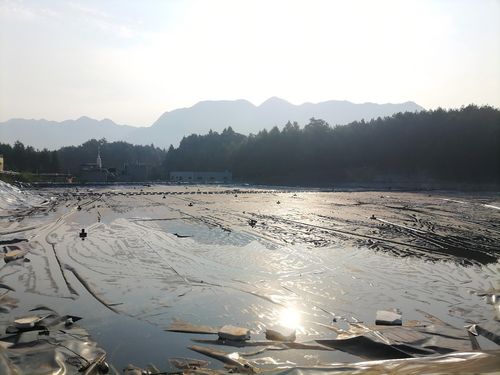
This case study outlines the application of ASTM Standard HDPE Geomembrane in landfill engineering, focusing on addressing critical environmental challenges through advanced material technology and standardized installation.
1.Environmental Risks and Compliance
In the development and operation of landfill sites, stakeholders often face severe challenges that can lead to project failure or legal liabilities:
-
Groundwater and Soil Contamination: The primary concern is sewage leakage (leachate). Without a reliable barrier, hazardous substances can infiltrate into the groundwater and surrounding soil, causing irreversible environmental damage.
- Material Degradation: Standard liners often fail due to prolonged exposure to strong sunlight (UV) and harsh chemical environments, leading to premature aging and cracking
- Physical Damage During Construction: Sharp objects like stones or tree roots on the base surface, or mechanical stress during backfilling, can cause punctures and defects in the anti-seepage layer

2. HDPE Geomembrane Anti-Seepage System
Jianyi HDPE Geomembrane as the core isolation layer, following a rigorous technical and installation framework:
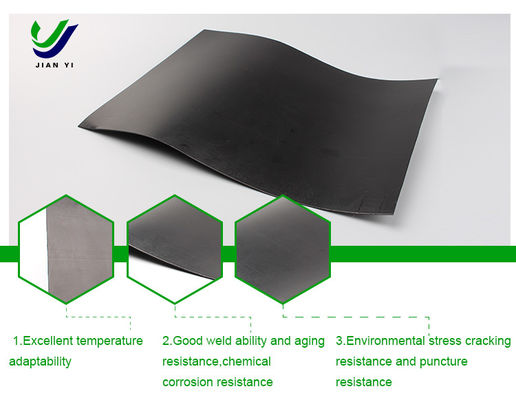
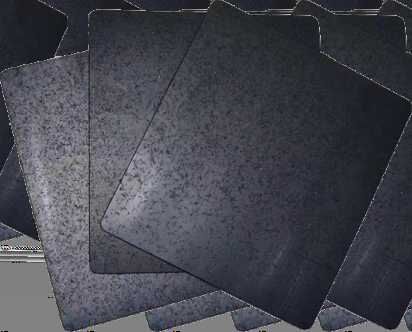
- High-Quality Raw Materials: The product is manufactured from 97.5% High-density polyethylene (HDPE) resin blended with 2.5% Carbon black, anti-aging agents, and UV absorbents.
- Advanced Manufacturing: Produced via a triple co-extrusion technique using automated equipment, ensuring the material meets or exceeds ASTM standards
- Precision Installation:
- Site Preparation: The base surface is cleaned, leveled, and compacted to remove sharp objects.
- Laying Requirements: Rolls are laid flat without tension, with an overlap width of 100-150mm.
- Thermal Welding: Specialized equipment performs welding at temperatures of 200-250°C and speeds of 2-5m/min, creating continuous and uniform seams.
- Rigorous Quality Control: Every weld undergoes an air pressure test—inflating the seam to a specified pressure to ensure it is 100% leak-proof.
3.Long-Term Environmental Protection
HDPE Geomembrane system delivered the following results:
Superior Leak Prevention: With a Water Vapor Transmission Coefficient of ≤1.0×10⁻¹³ g·cm/(cm²·s·Pa), the system forms an impenetrable anti-seepage barrier against leachate.
Exceptional Durability: The 2.0%-3.0% carbon black content and high-pressure Oxidation Induction Time (OIT) of ≥400 min guarantee
long-term anti-UV and anti-aging capabilities in outdoor environments.
Structural Integrity: With a Puncture Resistance Strength of up to 960N (for 3.00mm) and Breaking Elongation of ≥700%,
the liner successfully accommodates physical stress without compromising its isolation function.
Enhanced Service Life: By providing a robust protective layer and reliable welding, the landfill's structural durability and environmental safety are secured for decades.


 Your message must be between 20-3,000 characters!